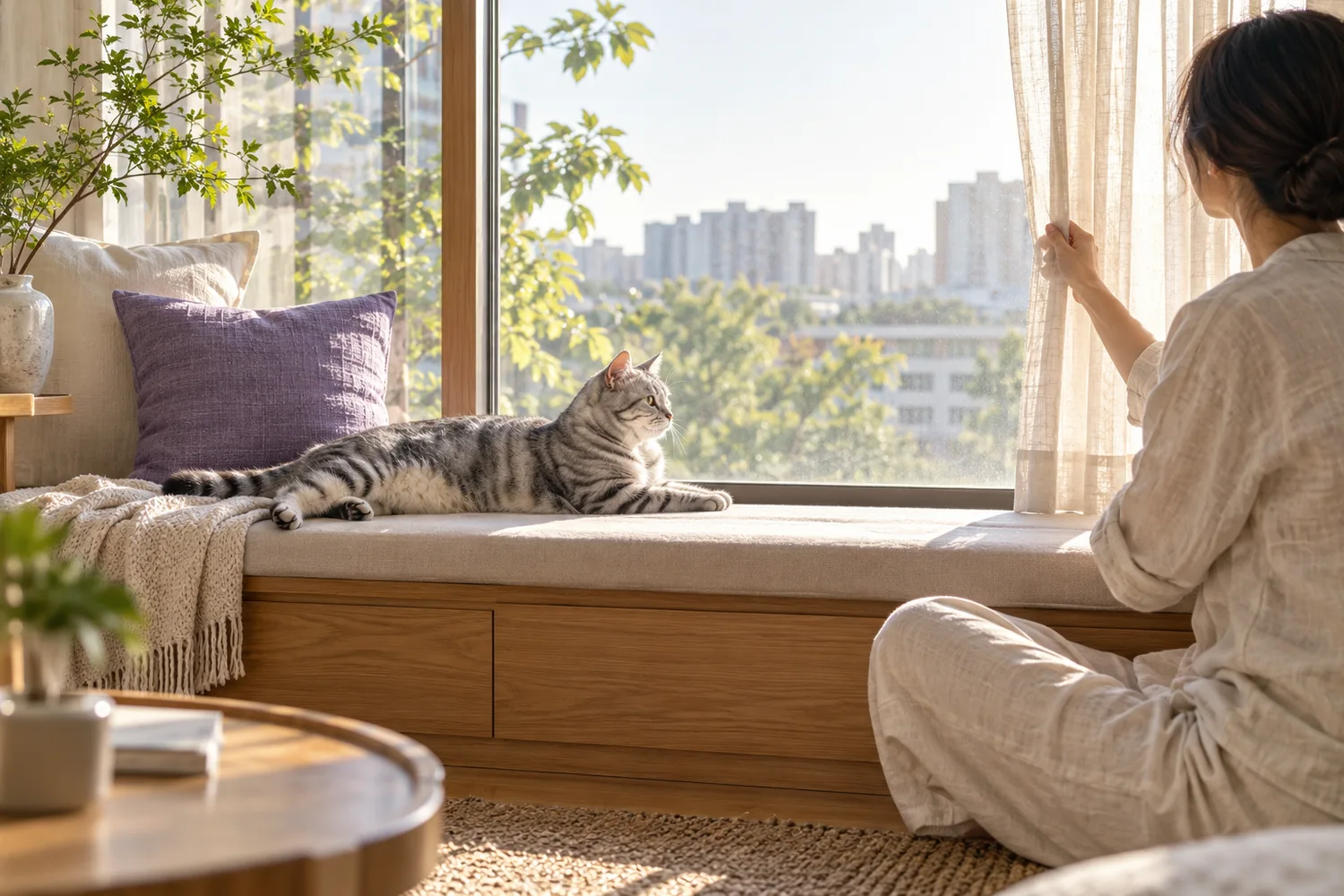
Imagine a friend visiting for coffee. Your cat has settled inside a covered bed, and your guest crouches down: “Can I just say hello?” A hand moves toward the opening. You hesitate because everyone means well, and asking someone to stop can feel less hospitable than letting the moment happen.
But that small hesitation is where a refuge becomes real—or stops being one.
Your cat needs a place to say no. That means more than buying an attractive bed or finding an unused corner. A refuge is a household agreement: when the cat chooses this place, people respect the choice. The furnishing gives the agreement a location. Your behaviour gives it meaning.
A covered bed is only the beginning
Hiding is not automatically a problem. Cats Protection explains that cats may hide for sleep, security, or play. It recommends quiet, covered retreats, raised where suitable, away from food, water, and litter, and in places the cat already likes. It also advises against coaxing a stressed cat out. Cats Protection: Cats hiding
Those recommendations establish a useful starting point. The harder question is what happens after you provide the place.
An enclosed bed does not automatically create privacy. If someone regularly peers inside, reaches through the entrance, or calls until the cat emerges, the enclosure offers cover without much control over contact. The household has supplied a boundary and then reserved the right to cross it.
Think of privacy here as a practical rule about access. Can your cat withdraw without turning that withdrawal into an invitation for more attention? That is a more useful purchasing question than whether a bed looks especially cosy in a photograph.
The room matters, but so does its routine
Consider two possible locations: beside a busy desk used for meetings, or in a quieter nook the cat already visits. The desk-side bed might fit the room beautifully. It might also sit within the route of every coffee refill, chair adjustment, and person stopping to talk.
Assess a location during ordinary household activity. Sit through a call. Notice where visitors stand. Watch what happens when someone needs something from the nearby shelf. These observations help you judge how often people would interrupt that particular spot.
The quieter nook deserves the same scrutiny. If reaching it requires your cat to pass through the centre of a gathering, its usefulness may change when company arrives. Treat the location as part of the room’s daily movement, not as a decorative destination considered in isolation.
You do not need to make the whole home silent. You need a workable agreement about where ordinary activity gives way to an undisturbed resting choice.
Being welcoming includes explaining the boundary
There is a fair counterargument: a home belongs to its human occupants too. You may want a tidy living room, comfortable guests, and a cat bed that does not dictate every furniture decision. A refuge that creates constant household friction may be difficult to maintain.
The answer is to make a modest, clear commitment you can keep. Choose a plausible location, then explain its purpose before a guest is already reaching inside. “That’s the cat’s quiet spot; let’s leave it alone” is sufficient. Nobody needs to be embarrassed or given a lecture.
Cats Protection advises letting a shy cat approach rather than forcing interaction, and asking family and visitors not to seek the cat out while it is hiding. Cats Protection: Shy cats
A practical extension is to avoid making an appearance the price of a successful visit. Your guest can enjoy the afternoon even if the cat remains elsewhere. You can be a generous host without promising access to your cat.
Use the approach, retreat, remain-undisturbed test
Before buying anything, try this decision framework with the places your cat already chooses.
Approach: Can the cat reach the spot during the situations when privacy would matter? Consider a busy evening as well as an empty room.
Retreat: Can the cat leave an interaction and settle there without someone following, calling, or reaching after it? Include your own habits in that assessment.
Remain undisturbed: Will the household honour the choice after the initial withdrawal? A retreat loses its purpose if everyone waits briefly and then resumes trying to engage.
These checks turn a vague intention to provide comfort into decisions you can observe and discuss.
Equipment choices involve separate questions. Robotail describes the C42 as having a semi-open entry and a removable roller. Those features concern choosing and maintaining a litter box; they do not establish that a cat feels secure or replace a private resting refuge. Robotail C42 manufacturer page

Official manufacturer illustration of the C42; not a refuge recommendation.
Respect the choice, notice the change
Respectful observation does not mean ignoring a change in behaviour. Cats Protection advises contacting a vet if your cat hides more than usual. Cats Protection: Cats hiding
Keep both responsibilities in view: honour an ordinary withdrawal, and notice when the pattern changes. A refuge is not permission to stop paying attention.
The most meaningful improvement may be a sentence everyone agrees to follow. When your cat retreats, the invitation to interact closes. Your home can remain lively, welcoming, and recognisably yours while making room for that answer.