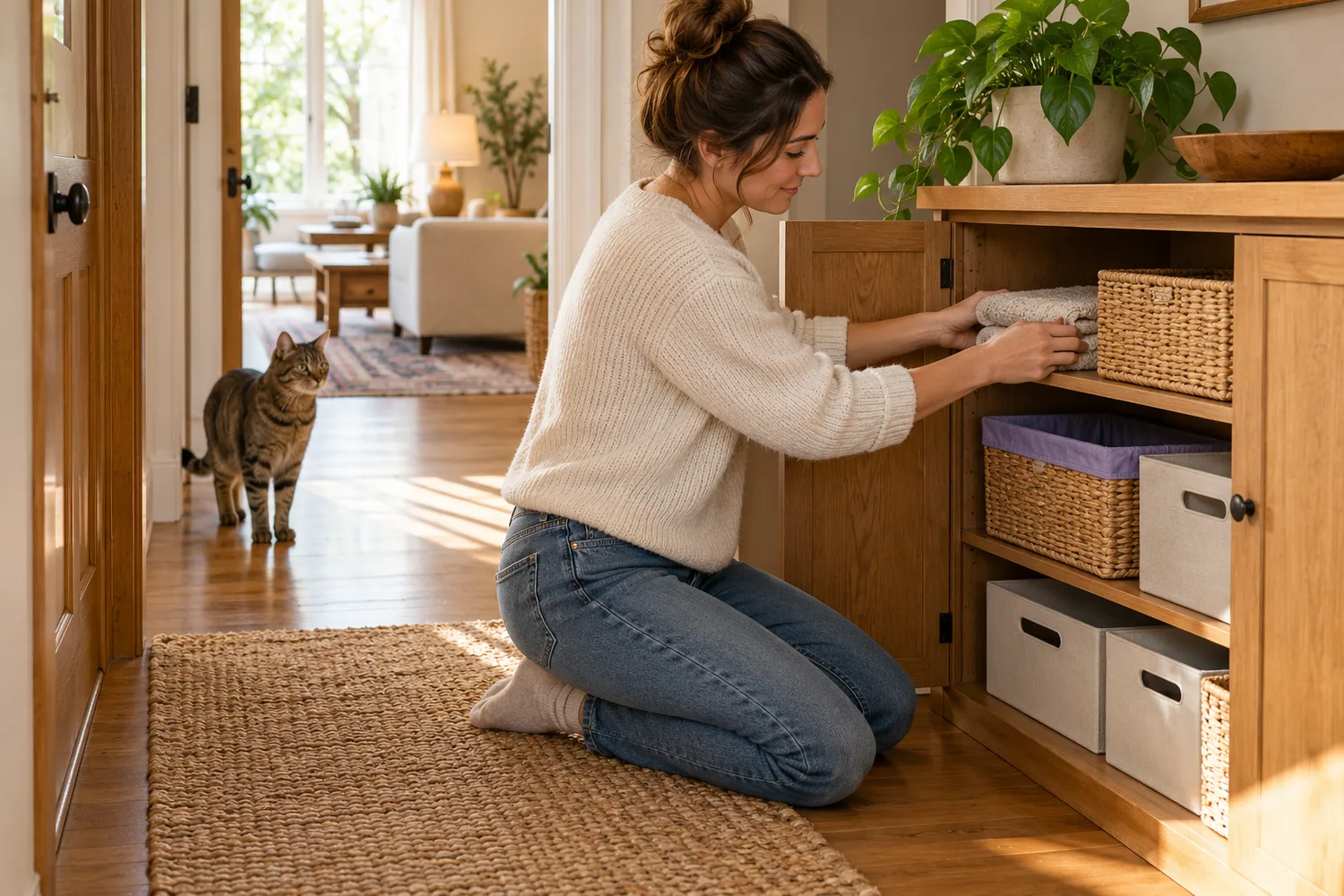
Imagine a cleaning day at home. The litter box fits neatly beneath a cabinet, exactly where you hoped it would go. Then you discover that the drum cannot come out beneath that low shelf. The sink is across the apartment, the drying spot is occupied, and nobody has decided who handles the waste bag.
That is a hypothetical scene, but it captures a useful buying question: does the equipment fit the work, or just the space?
Self-cleaning can be valuable. The mistake is assessing convenience only at the moment an automatic cycle finishes. A better purchase decision considers the whole maintenance workflow: the repetitive task a machine takes over, the manual tasks that remain, and whether those tasks have a realistic place in your home.
Follow the work beyond the automatic cycle
For buying purposes, separate two kinds of work. One is the frequent, repetitive cycle that attracts attention in a demonstration. The other is periodic manual care: removing components, cleaning them, managing waste, arranging drying space, and putting everything back into service.
Different designs divide these tasks differently. The point is to make the remaining work visible before you commit.
Convenience can remove some work and relocate the rest. A task that once happened at the tray may become a task at the waste compartment, sink, or storage cupboard. That can be a worthwhile exchange. But an exchange deserves examination: who does it, where does it happen, and what makes it easy enough to repeat?
The relevant comparison is between complete routines. A feature can be appealing while the surrounding routine is awkward. Equally, a machine can retain manual chores and still suit your household very well.
Imagine cleaning day, not just installation day
Before buying, walk through an imagined maintenance session. Start at the intended location and trace the route to wherever removable parts would be cleaned. Look at doorways, furniture, and the surfaces you would need along the way.
Measure the access needed to remove parts, using the corresponding instructions and confirmed product information. Overall dimensions alone do not answer whether you can actually dismantle something in its intended position. A box that fits beneath a cabinet may still need to be moved before its drum can be removed.
Next, assign a drying area and a protected place for the base while the removable component is being cleaned. Making those arrangements beforehand avoids discovering halfway through the job that every usable surface already has another purpose.
Follow the waste handoff, too. Decide who replaces the bag and where it goes next. Then consider care while the unit is offline: plan an appropriate familiar tray for your cat rather than leaving that decision until the equipment is apart.
Read the maintenance page as purchase information
The official UCAT C42 manual makes the division of work concrete. Section 6 says to clear the waste bin, then unplug before removing the drum. The drum can be washed and drained, and must air-dry thoroughly before reassembly. The base is wiped with a soft damp cloth; it must not be rinsed or immersed. Bag replacement is a separate task. Consult the exact model manual for the full procedure. Official UCAT C42 manual
Those details belong in a buying decision because they imply household arrangements. Where will the removable part go? What space can remain occupied while it dries? Who owns the job from beginning to end?
There is also a distinction between owning a task and helping with it. “Someone will clean it” leaves the responsibility unresolved. Naming a person, with an agreed handoff when needed, turns an attractive purchase into a workable household arrangement.
A concrete Robotail example
Robotail describes the C42 as having a removable roller. Manufacturer product page

Official manufacturer illustration; not a hands-on test.
The Amazon listing identifies its item model as C42C. That alone does not establish that the UCAT C42 manual covers every suffix or configuration. If your label differs, confirm the corresponding manual. Amazon listing
Ask five questions before buying
Use these questions to turn that imagined cleaning day into a decision:
- Which repetitive task am I choosing to automate, and which manual tasks am I accepting?
- Can I remove the required components in the intended location and carry them to the cleaning area?
- Where will parts dry, where will the base stay, and what familiar tray will my cat use meanwhile?
- Who owns cleaning, bag replacement, and the final waste handoff?
- Have I confirmed the corresponding manual and compatible replacement supplies for the exact unit?
A simple manual tray may suit someone who prefers fewer components and a more direct routine. That is a legitimate preference. Automation can also be valuable when its remaining chores fit the household; acknowledging those chores makes the decision stronger.
Before you buy, evaluate the maintenance page before the feature list. Choose the routine you are willing to maintain, including the moments when the automatic part is not doing the work.