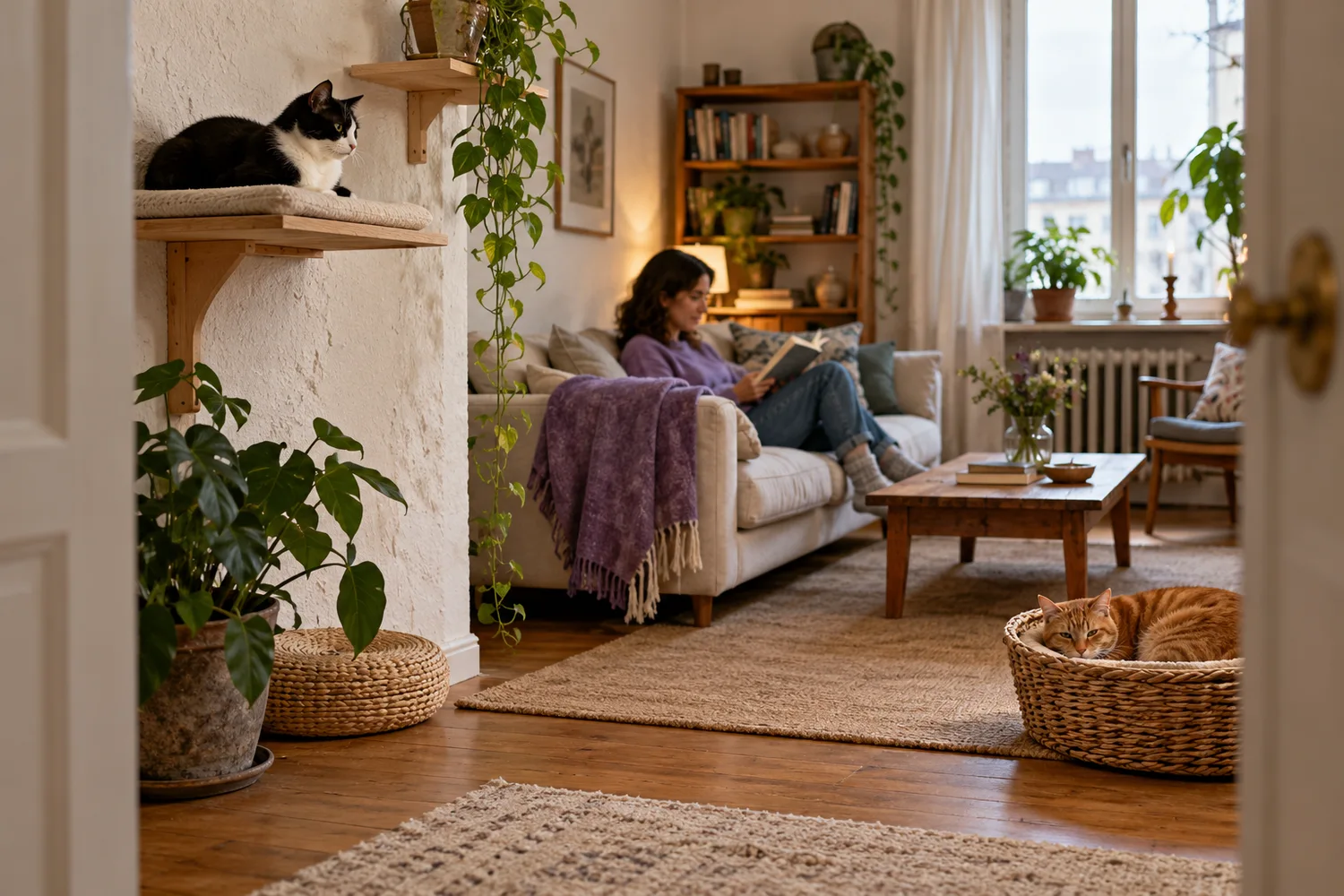
Imagine you have just rearranged the living room. The sofa finally fits, the lamp has a sensible home, and the scratching post looks wonderfully discreet behind an armchair. Then your cat walks past that hidden corner and scratches the sofa again.
That hypothetical scene contains a useful design question: did the scratching area get a place in the room, or merely somewhere to be stored?
Functional scratching belongs where your cat actually uses the room. Aesthetics are a legitimate constraint, but the better sequence is to observe behaviour, plan the space, and then buy something that fits both.
Start with the room you have
A scratching product can look appropriate in isolation and still be awkward in context. Its colour might suit the rug while its position makes little sense along your cat’s usual route.
Before shopping, watch a few ordinary moments: waking up, entering the room, crossing towards a favourite seat. Make a rough sketch with the furniture, doorways and resting places marked. Draw the routes you actually see, leaving uncertain routes as questions.
This need not become an elaborate tracking project. The point is to replace “there is room in that corner” with a more useful question: “what makes that corner a plausible place to scratch?”
An empty corner offers available floor space. Whether your cat will use it remains a hypothesis.
Separate four decisions
Treat location, surface, orientation and room traffic as separate parts of the brief. Otherwise, a disappointing purchase can leave you unsure what to change.
Location: Where does scratching already happen? Which nearby positions could accommodate a scratching area without blocking access or making the room difficult to use?
Surface: What material is being scratched? Record the observation rather than assuming that a particular colour, label or premium finish will matter to your cat.
Orientation: Is the action happening against an upright surface or across something flat? That distinction deserves attention before you choose a tall post simply because it looks like the standard solution.
Room traffic: Can the proposed spot coexist with opening doors, moving chairs and everyday walking routes? A placement that repeatedly gets moved aside is unlikely to remain a dependable part of the room.
These observations create a buying brief. They do not guarantee acceptance, but they give you something concrete to reconsider if the first arrangement fails.
Use practical guidance as a starting point
Cats Protection’s scratching guidance recommends placing a scratching post beside the area already being scratched. It advises a heavy, stable base and enough height for a full stretch, with a horizontal pad as an option for cats that prefer scratching horizontally. A scratching opportunity near a sleeping place can suit the stretch after waking. Once a post is being used, it can be moved gradually if necessary.
Apply that guidance to your floor plan. If the sofa corner is the relevant location, begin by working out what can reasonably fit nearby. Do not let a beautiful unused corner win the decision before you have considered the occupied one.
Take the design objection seriously
There is a fair counterpoint: floor space matters, and a large object beside the sofa may be impractical. Someone has to walk through that gap, open that cupboard or clean around that base.
You do not have to abandon those needs. Write them into the brief alongside the scratching observations. Set a usable footprint, consider how visible the object will be, and compare options within those limits.
Sketch the walking route before committing to one giant post. Size alone cannot resolve a poor location, and a room that becomes inconvenient for you may invite constant rearrangement.
Interchangeable scratching surfaces may offer flexibility where a suitable product provides them. Check the intended replacement options before buying; avoid assuming that unrelated pieces can be adapted together. The useful question is whether you can replace the working surface while keeping an arrangement that already fits.
Let convenience support the purpose
The Robotail C42 manufacturer page describes a semi-open entry and a removable roller. That offers a brief design parallel: convenience should serve function. It does not replace a scratching area.

Official manufacturer product photograph: Robotail C42, included as an equipment design illustration, not as a scratching solution.
Judge the arrangement before the photograph
After placing a scratching option, return to the brief: is it accessible, does its orientation match what you observed, and can it stay in place during normal room use? If you revise the arrangement, make a deliberate change so you can understand your next observation.
A coherent room can include visible evidence that a cat lives there. The aim is a home whose appearance and daily use support each other, with scratching given a considered place in the plan.